Hong Z. Tan
PhD, FIEEE
Purdue University EE Building
465 Northwestern Avenue
West Lafayette, IN 47907
Office: +1.765.494.6416
Email: 
|
Hong Z. Tan is the Keysight Professor in the Elmore Family School of
Electrical and Computer
Engineering at Purdue University.
She concurrently holds courtesy appointments in the School of Mechanical Engineering and
the Department of Psychological Sciences at Purdue University. Her research focuses on
haptic human-machine interfaces and haptic perception.
She has published more than 160 peer-reviewed journal and conference
articles in haptics research. She is known internationally as a leading
expert on haptics psychophysics, taking a perception-based approach to
solving engineering problems. She is frequently invited to give keynote
speeches at international conferences and research institutions,
educating a broad
audience on haptics and its emerging applications in human computer
interaction, robotics, medicine and education.
Tan received her
Bachelor's degree in Biomedical Engineering from Shanghai Jiao Tong
University, P.R. China. She earned her Master and Doctorate degrees, both
in Electrical Engineering and Computer Science, from Massachusetts
Institute of Technology (MIT). She was a Research Scientist at the MIT
Media Lab before joining the faculty at Purdue's School of
Electrical and Computer Engineering in 1998. She has held a McDonnell
Visiting Fellowship at Oxford University, a Visiting Associate
Professorship in the Department of Computer Science at Stanford
University, and a Guest Researcher position in the Institute of Life
Science and Technology at Shanghai Jiao Tong University. From 2011-2015,
Tan was a Visiting Researcher, then a Senior Researcher and Research
Manager at Microsoft Research Asia in Beijing, China. She is currently
on research leave from Purdue University, holding a visiting position
as the Lead Haptics Scientist at Google LLC.
Tan was a recipient of the prestigious US National
Science Foundation's Early Faculty Development (CAREER) Award. She
was a Chinese National Natural Science Funds' Distinguished (Overseas)
Young Scholar.
In addition to serving on numerous program committees,
she was a co-organizer (with Blake
Hannaford) of the International Symposium on Haptic Interfaces for
Virtual Environment and Teleoperator Systems from 2003 to 2005.
In 2006, Tan served as the Founding Chair of the IEEE Technical
Committee on Haptics (TCH). The TCH played a key role in
launching the IEEE Transactions on Haptics (ToH) in 2008.
Tan has served as a ToH Associate Editor from the journal's birth to
2012, and received a Meritorious Service Award in 2012.
From 2012-2015, Tan was the Editor-in-Chief of the
World Haptics Conference Editorial Board, and co-chaired
the World Haptics Conference with Ed Colgate in 2015.
In 2017, Tan was elevated to IEEE Fellow for
"contributions to wearable haptics."
|
Publications (on a separate page)
Google Scholar Citation
Highlighted Projects
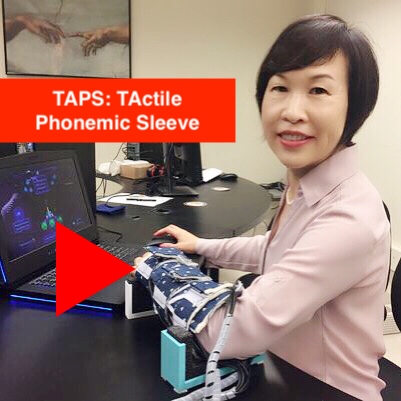
TAPS (TActile Phonemic Sleeve) for Speech Communication through the Skin
We devised a phonemic-based approach to encoding speech sounds (phonemes) as
vibrotactile stimulation patterns on the forearm, conveyed through a 4-by-6 tactor
array. We have tested about 100 participants on TAPS. Our results show that the
best participants can learn up to 500 English words at a rate of 1 word per minute!
Select Publications:
 Our paper won the IEEE Transactions on Haptics (ToH)
Best Paper Award 2020,
funded by IEEE Robotics and Automation Society to recognize the best ToH paper
published in calendar year 2019.
Our paper won the IEEE Transactions on Haptics (ToH)
Best Paper Award 2020,
funded by IEEE Robotics and Automation Society to recognize the best ToH paper
published in calendar year 2019.
Charlotte M. Reed, Hong Z. Tan, Zachary D. Perez, E. Courtenay Wilson,
Frederico M. Severgnini, Jaehong Jung, Juan S. Martinez, Yang Jiao, Ali Israr,
Frances Lau, Keith Klumb, Robert Turcott, and Freddy Abnousi,
"A phonemic-based haptic display for speech communication,"
IEEE Transactions on Haptics, Vol. 12, No. 1, pp. 2-17, 2019.
(This article explains the design approach of 39 vibrotactile
patterns for the 39 English phonemes, and provides the details of the 24 position-based consonant codes
and the 15 movement-based vowel codes.)
Hong Z. Tan, Charlotte M. Reed, Yang Jiao, Zachary D. Perez, E. Courtenay Wilson,
Jaehong Jung, Juan S. Sebastian, and Frederico M. Severgnini,
"Acquisition of 500 English words through a TActile Phonemic Sleeve (TAPS),"
to appear in IEEE Transactions on Haptics, 2020.
(This article presents results in terms of total learning
time and word recognition accuracy from 51 participants who were trained to receive
up to 500 English words using the TAPS.)
Hong Z. Tan, Seungmoon Choi, Frances W. Y. Lau, and Freddy Abnousi,
"Methodologyy for maximizing information transmission of haptic devices: A survey,"
Proceedings of the IEEE, Vol. 108, No. 6, pp. 945-965, 2020.
(This article was actually the "literature review" for the TAPS project, even though
it took longer to be published. A practical and useful insight is that movement-based haptic stimuli is
vivid and distinct, and highly effective at increasing the information transmission of haptic devices.)
Juan S. Martinez, Lori L. Holt, Charlotte M. Reed, and Hong Z. Tan,
"Incidental categorization of vibrotactile stimuli,"
IEEE Transactions on Haptics, Vol. 13, No. 1, pp. 73-79, 2020.
(This article demonstrates that task-irrelevant position-based and movement-based
vibrotactile stimuli can be categorized without explicit attention during a visuomotor task.)
Juan S. Martinez, Hong Z. Tan, and Charlotte M. Reed,
"Improving tactile codes for increased speech communication rates in a phonemic-based tactile display,"
IEEE Transactions on Haptics, Vol. 14, No. 1, pp.200-211, 2021.
(In this article, we revise our haptic phonemic codes by taking into account the frequency of
occurrence of phonemes and phoneme pairs. We show that speech transmission rates could be improved by more
than 50%.)
|
Video of TAPS
Funding:


Faculty Research Award (2018)
Faculty Research Award
(2019)

|
Virtual Reality for Sports Training
We have developed three VR
applications for sports training -- footbal (receiver training for
catching a football from any direction), baseball (hand-eye coordination
training), and Taekwondo (training for kicking/breaking a target).
We use haptic feedback to indicate collision with a virtual object
(e.g., a baseball bat).
|
Haptic Signal Design for Emotional Communication
How do we design haptic signals that feel like natural phenomena?
We work with designers to explore ways that vibrotactile patterns can
capture the essence of breathing, heartbeat, earthquake, bubbles, etc.
Our ultimate goal is to achieve visceral reactions to hand-crafted haptic
signals.
Select Publications:
Sang-Won Shim and Hong Z. Tan,
"palmScape: Calm and pleasant vibrotactile signal,"
in A. Marcus and E. Rosenzweig (Eds.),
Design, User Experience, and Usability, Interaction Design, Proceedings of the 22nd HCI International
Conference (HCII 2020, Part I). Lecture Notes in Computer Science Vol. 12200, Springer, Cham, pp. 532-548, 2020.
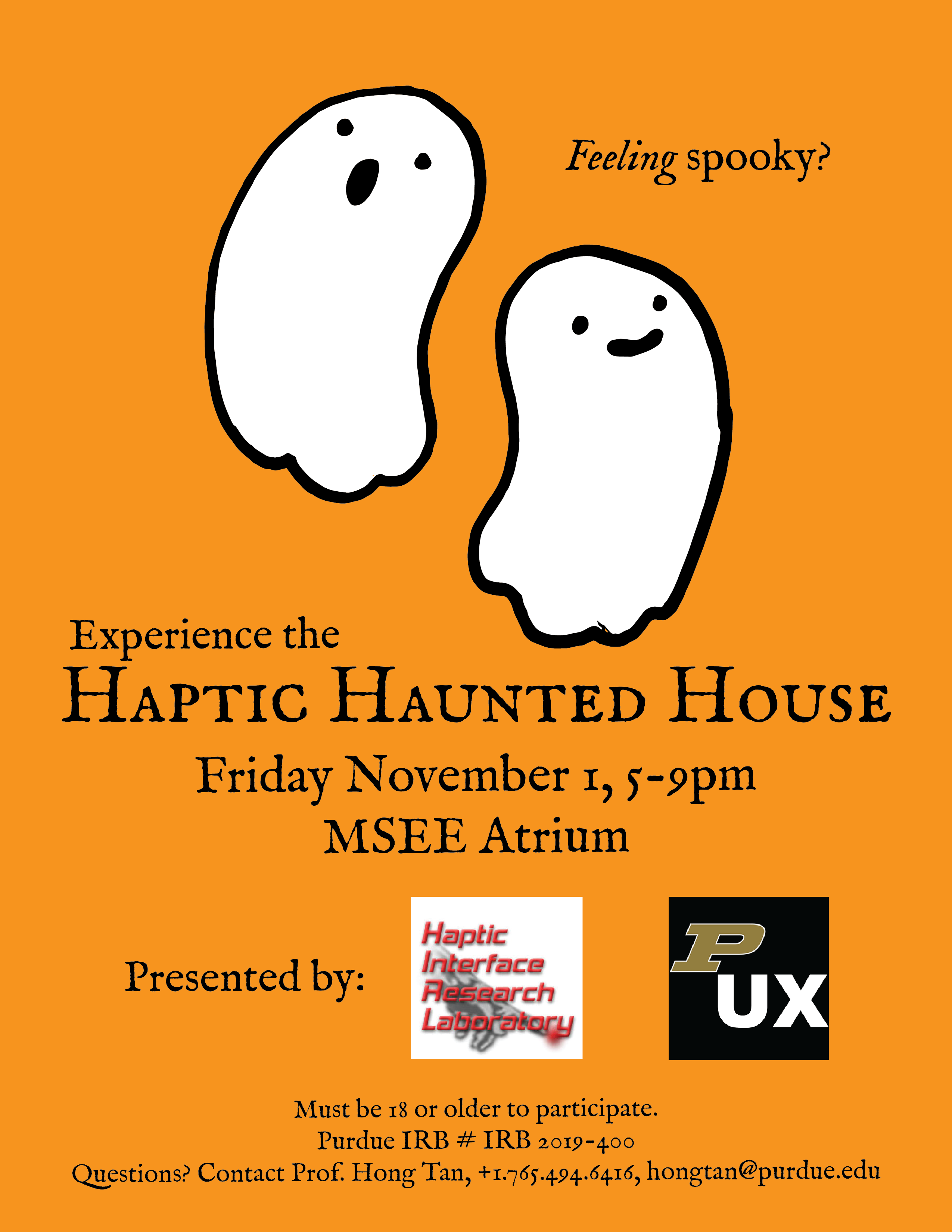
Gina Clepper, Juan Sebastian Martinez, Ahmed Farooq, Alyse Marie Allred, Kevin McDonald, Ian Carr, Austin Toombs, and Hong Z. Tan,
"Feeling creepy: A haptic haunted house,"
Work in Progress Paper, in Proceedings of the IEEE Haptics Symposium, March 28-31, pp. 562-563, 2020.
|
Video of Haptic Haunted House
|
Select Past Projects (Videos)