My research draws from the areas of machine learning,
probabilistic modeling of information, geometry of physical
and data spaces, the theory of
computational complexity, and notions important to
programming languages and software design:
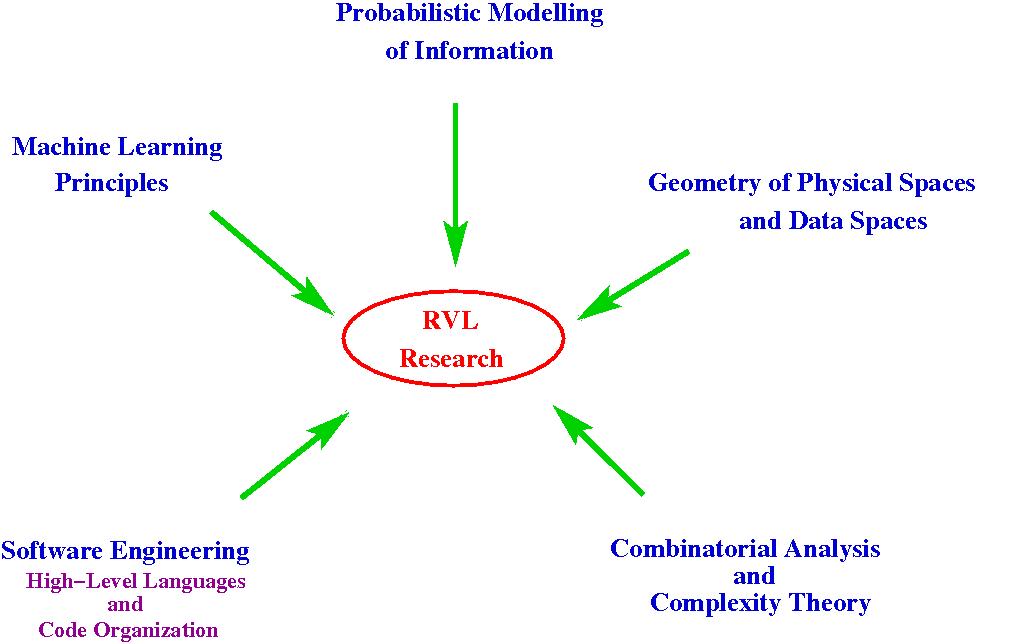
I like to use these foundational ideas to solve interesting
problems in sensor networks, robotics (including computer
vision), and software engineering. Here are some of the key
contributions my lab has made during the last five years:
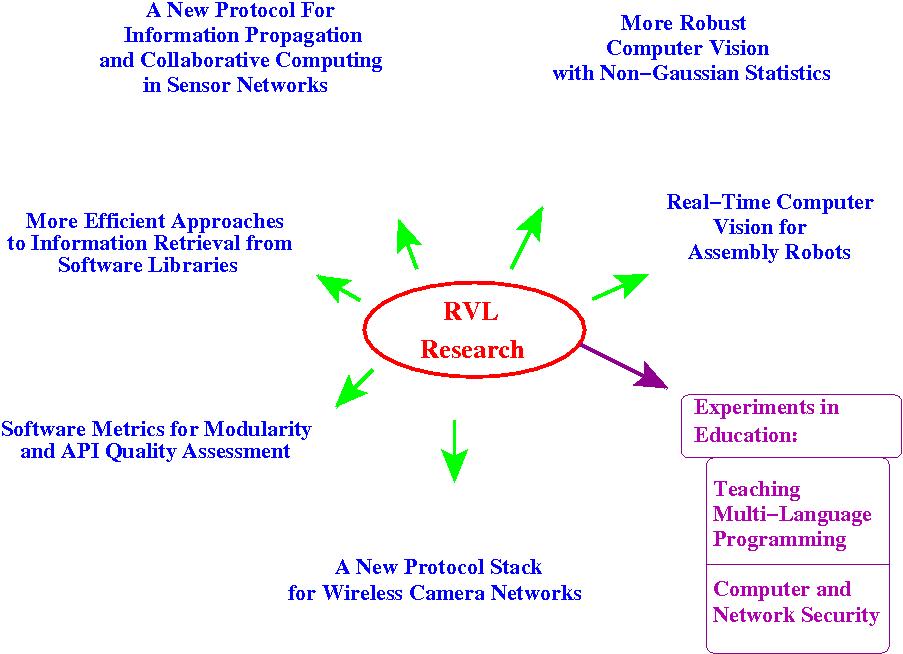
With regard to sensor networks, I am as interested in
the networking aspects of
wireless cameras working together as I am in how
distributed computations can be carried out in such
networks. My interest in wireless sensor networks has
also taken me into the domain of
computer and network security because when you
try to create wireless-based systems for distributed
intelligence, you have no choice but to pay close
attention to the security aspects of the communication
between the nodes.
With regard to robotics and computer vision, I am
particularly interested in issues related to object
tracking and visual servoing.
I am also strongly interested in high-level
programming languages and those aspects of
software engineering that relate to lending
organization to software so that it can be extended and
maintained easily.
If you are a student and if you wish to work with me, there are a number
of entry points into my research. I believe
any research-minded student with a background in computer-related,
signal-processing-related, or controls-related areas could
do productive work along the lines of my research. At some point,
the student would need to take our courses in networking, computer vision,
machine learning, data mining, etc. The math courses that
are useful for this kind of research are those that deal with graph
theory, differential geometry, algebraic topology, etc.
Over the years I have noticed that the students who excel in
the kinds of things I do are those who are intrigued by how
humans think, by the mysteries of human perceptual faculties, and by the
question of whether or
not computers can be endowed with any of human sensori-motor
capabilities, even at primitive levels.
Students who have finished their Ph.D under my supervision
(fiftyfour so far) have gone
on to occupy challenging positions in academia and industry.
Universities where some of these students currently work
include University of Illinois, Ohio State, University of
California, KAIST, and others, and those who are in industry have
gone to places like IBM, GE, AT&T, Interval, Apple, SRI
International, Siemens Research, Adept Robotics, Analogic,
Honeywell, Sandia Labs, ERIM, TASK, and others.
The RVL alumni who have attained the highest rank in
academia include Kim Boyer, formerly a
full Professor of ECE at Ohio-State University and now
a Dean of the College of Engineering,
State University of New York, Albany;
Seth Hutchinson, used to be a professor at the University
of Illinois and is now a distinguished professor at
Georgia Tech; Chi-Ren
Shyu, a distinguished professor in the College of
Engineering of the University of Missouri; Mostafa Fatemi, full
professor of biomedical engineering at the Mayo Clinic, and Hyun
Yang, a full professor at KAIST in Korea. And, the RVL
alumnus who has risen the highest in industry is Carl
Crawford, formerly a Vice-President at Analogic
Corporation and currently an independent consultant to
industry and to the Department of Homeland Security.
For a fuller account of my former students who have become luminaries in their
own right, you'd need to know about Charles Jakowatz, Carl Crawford, Malcolm
Slaney, David Nahamoo, Mostafa Fatemi,
Keith Andress, Hyun Yang, Akio
Kosaka, Chi-Ren Shyu, Hyun Yang, Seth Hutchinson, Henry Medeiros, Bunyamin Sisman,
Shivani Rao and several others.
Charles "Jack" Jakowatz, my first Ph.D. student, has become one of
the leading figures in the country in synthetic aperture imaging. An
author of a well-known text on the topic of synthetic
aperture imaging, Jack is currently a group leader at Sandia Nation
Lab.
Carl Crawford holds several key patents in CT imaging
and is currently an Associate Editor of the IEEE
Transactions on Medical Imaging. Besides being a co-author
on one of my books,
Mostafa Fatemi is a professor of biomedical engineerint at the Mayo Clinic
and a key developer of several ultrasound based diagnostic toools.
Malcolm Slaney was one of
the key researchers at Interval Corporation, a new west-coast company
that was established by the Microsoft co-founder Paul Allen as an incubator of new
ideas in high technology. Malcolm is now with Google Research in California.
David Nahamoo is the Head of the Human Languages Technologies Department at the
IBM T. J. Watson Research Center, Yorktown Heights, NY. He was much in
the news several years back when his 60-person group developed the much talked about
ViaVoice and MedSpeak voice recognition IBM products.
Keith Andress is currently the Director of Software
Engineering at Seimens Medical Solutions, Nuclear Medicine
Group.
Hyun Yang, as a professor in the
prestigious Korea Advanced Insitute of Technology, has emerged as one of the
leading researchers in Korea in areas such as neural networks and robotics.
Chi-Ren Shyu is a distinguished professor at the University of Missouri
and the Director of the Informatics Institute there.
Akio Kosaka, in his capacity as a
member of the research staff of Olympus Corporation in Japan, is
investigating new ways of combining computer image processing with
digital imaging devices. Seth Hutchinson, now a distinguished professor
at Georgia Tech, has made a name for
himself by doing pioneering work in vision-guided servoing of robots.
Johnny Park owns what is surely one of the most successful startups
in Purdue Research Park --- the name of his company is Spensa.
Henry Medeiros has joined the faculty at Marquette
University. I tried very hard to keep Henry at Purdue, but
he had what is now commonly called the two-body problem,
meaning that he could only go to an organization that
offered both him and his wife faculty positions.
|

